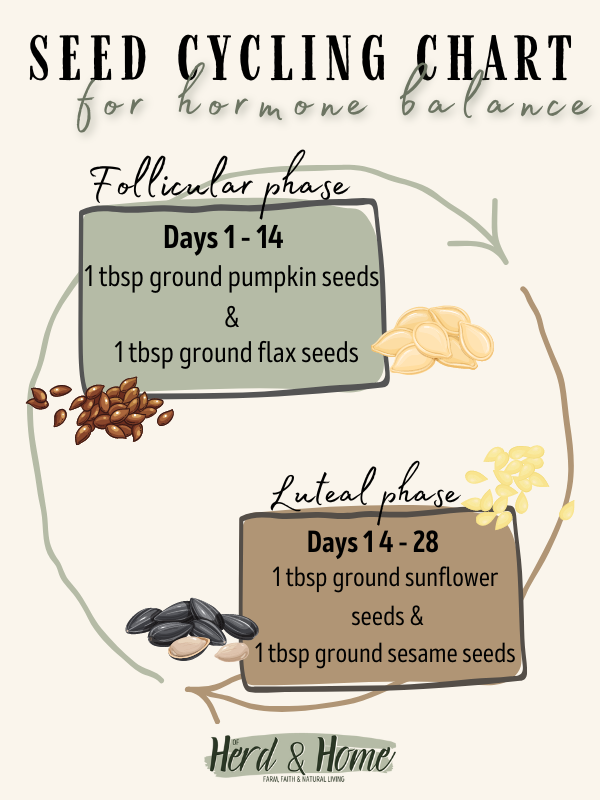
Seed cycling is a naturopathic practice that involves eating four types of seeds during specific phases of a woman’s menstrual cycle to help regulate hormones. During the follicular phase (weeks 1 and 2) of your cycle, you consume ground pumpkin seeds and flax seeds, which have been shown to balance estrogen. During the luteal phase (weeks 3 and 4) of your cycle, you consume ground sunflower and sesame seeds, which are known to promote progesterone.
Of course, the million-dollar question here is, “Does seed cycling really work?” The short answer is that there aren’t any clinical studies to answer yea or nay, but the long answer certainly points to some convincing evidence that seed cycling can help to balance hormones. I’ll dig into those details here.
How Does Seed Cycling Work?
The concept of seed cycling is centered around the natural ebb and flow of your menstrual cycle. During the follicular phase – which begins on the first day of your period and ends at ovulation – estrogen plays an important role in thickening the lining of your uterus, called the endometrium, in preparation for the implantation of a fertilized egg.
Without a thick enough uterine lining, a fertilized egg may not be able to successfully implant and result in a pregnancy. On the other hand, too much estrogen can cause other problems, such as heavy or irregular periods or fibroids.
This is where pumpkin and flax seeds come in. These seeds contain naturally-occuring phytoestrogens called lignans, which have the amazing ability to not only raise low estrogen levels but also lower estrogen levels that are too high. Additionally, flax seeds have been shown to help lower blood sugar levels, which can be very beneficial to women struggling with PCOS, while pumpkin seeds are rich in zinc and magnesium, two crucial nutrients for hormone regulation in both women and men.
During the luteal phase of your cycle – which begins the day you ovulate and ends the day before your next period – the hormone progesterone takes center stage. Once estrogen has thickened the uterine lining, progesterone takes over to stabilize it and ensure it is a hospitable and nutritional environment for a fertilized egg to implant. If you become pregnant, progesterone levels continue to increase.
Low progesterone in the luteal phase can make it difficult to become pregnant, since progesterone is responsible for making a suitable “home” in your uterine line for the egg. Without the proper conditions, implantation won’t occur and therefore neither will a pregnancy.
Sunflower and sesame seeds are recommended during this phase of your cycle because both are rich in vitamin E and selenium, two important nutrients that have been shown to increase progesterone in animal studies. These seeds also contain lignans, which can help to regulate too-high estrogen levels, as we discussed above.
Finally, all four of these seeds are high in omega-3 fatty acids, which play a vital role in hormone signaling, as well as possess strong anti-inflammatory properties.
How to Seed Cycle
You’ll need:
- Pumpkin seeds (unsalted, unroasted)
- Flax seeds (unsalted, unroasted)
- Sunflower seeds (unsalted, unroasted)
- Sesame seeds (unsalted, unroasted)
- Grinder
- Tablespoon measuring spoon
Instructions:
- Eat 1 tablespoon ground pumpkin seeds and 1 tablespoon ground flax seeds during weeks 1 and 2 of your cycle.
- Eat 1 tablespoon ground sunflower seeds and 1 tablespoon ground sesame seeds during weeks 2 and 3 of your cycle.
I used a coffee grinder to grind my seeds fresh every morning. You could also grind a week’s worth of seeds at once, but be sure to keep them in an air-tight container in the fridge and limit exposure to light. The fatty acids in these seeds can go rancid fairly quickly if exposed to light, heat, or air.
You can eat your ground seeds on their own or mixed into just about any food. I found they go great in yogurt, on top of salads, and in oatmeal.
Do You Have to Use Ground Seeds for Seed Cycling?
No, you don’t have to grind the seeds first, but grinding them can help to increase absorption. Unground, it’s very easy for the seeds (especially the small flax and sesame seeds) to pass whole through your digestive system and not impart much nutritional value, if any, along the way.
That said, as I noted above, if you are going to grind your seeds first, it is best to use fresh ground. If you aren’t able to grind them fresh or properly store a week’s worth at a time, you might want to skip this step and just make sure you chew them extra.
Does Seed Cycling Really Work for Fertility?
So far, there aren’t any formal studies examining the effects of the seed cycling protocol on fertility. However, as Functional Medicine Naturopathic Physician Dr. Jolene Brighten points out, a potential return on investment (ROI) is typically at the center of most scientific research that is performed today. So if there is no financial benefit of researching the effects of inexpensive seed cycling on fertility, there likely won’t be a study any time soon.
However, there is a robust body of scientific research on the various hormonal effects of each of the seeds used in seed cycling, so we can say that consuming certain seeds in general comes with a variety of science-backed benefits. Whether or not it matters when in your menstrual cycle you eat those seeds is still up for debate.
Of course, seed cycling should be combined with other healthy lifestyle adjustments to reap the most benefits and avoid canceling out any potential benefits of seed cycling with unhealthy habits. Limiting sugar and alcohol consumption, getting adequate exercise, getting enough sleep, and managing stress are all important lifestyle habits that can have a profound effect on fertility and your overall health.
How Long Does Seed Cycling Take to Work?
It can take around three months for dietary changes like seed cycling to begin to have a noticeable effect on your hormones. Stick with it for at least this long before reassessing how you feel and whether or not seed cycling seems to be beneficial for you.
Could Seed Cycling Be Harmful?
No, there aren’t any harmful effects of eating these seeds. The worst that could happen is that seed cycling doesn’t end up having a significant effect on your hormones or fertility. But even if this is the case, all four of the seeds used in seed cycling come along with health benefits outside of seed cycling, so it’s not a total loss if it doesn’t end up helping you get pregnant.
The Verdict: Is Seed Cycling Worth It?
Yes, seed cycling is worth a try if you are trying to balance your hormones naturally. At best, it can be a natural and inexpensive way to improve your hormone balance and at worst, it costs you a couple bucks for the seeds if you don’t see noticeable results.
Keep in mind that it can take several cycles to see results, so keep up with it even if you don’t notice any benefits the first month.